Advertisement.
EnchantedLearning.com is a user-supported site.
As a bonus, site members have access to a banner-ad-free version of the site, with print-friendly pages.
Click here to learn more.
(Already a member? Click here.)
Old Questions
Questions from March 1998
Q: what dinosaurs ate humans? if any did
from sarah, tulsa, ok, USA; March 31, 1998
A: None. The dinosaurs lived and went extinct millions of years before people evolved.
Q: what was the life span of the velociraptor?
from Dustin D., La Palma, CA, USA; March 31, 1998
A: Estimating a dinosaur's life-span is guesswork. It depends on a lot of factors including whether they were warm-blooded or cold-blooded (and this controversy has not been settled). Also, most dinosaurs, like other wild creatures, die long before their optimal age from attacks, disease, injuries, natural disasters, etc. I've never seen an estimate of Velociraptor's life-span.
Q: How many different types of dinosaurs are there?
from summer, Port Charlotte, FL, USA; March 31, 1998
A: There are about 330 described dinosaur genera, and many time that number of genera that probably existed but we haven't found yet - probably thousands. There are many times that number of dinosaur species that existed, only about 600-700 have been named, but some of these are doubtful (they may be juveniles of other species, examples of a different gender, or very large or small specimens of a known species).
Q: what era is known as the "Age of Reptiles"?
from ?; March 31, 1998
A: The Mesozoic Era.
Q: where did the Albertosaurus live?
from phylecia, buena park, CA, USA; March 31, 1998
A: Albertosaurus means "lizard from Alberta." Its fossils have been found in Alberta, Canada and the western U.S.A. For an information sheet on Albertosaurus, click here.
Q: WHAT ERA DID THE FIRST LIFE FORMS MOVE FROM SEA TO LAND?
from ???; March 31, 1998
A: During the Devonian period (410 to 360 Million Years Ago), both primitive tetrapods (vertebrates which included lungfish and amphibians) and arthropods (which included wingless insects and early arachnids) went on land for the first time. For an extensive geologic time chart, click here.
Q: how big are the t-rex bones in the head?
from ???; March 31, 1998
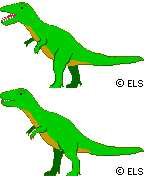 A: Most of T. rex's skull was jaws. These huge jaws were up to 4-feet (1.2 m) long. T. rex had over 60 sharp teeth in these jaws. For more information on T. rex, click here.
Q: Where did Edmontonia live in and what ese is interesting to know? I need info as soon as possibe!
from somebody, La Palma, CA, USA; March 31, 1998
A: Edmontonia fossils have been found in Alberta, Canada. It lived during the very warm late Cretaceous period and was a large, armored, quadrupedal (walked on four legs) plant-eater. Edmontonia had to eat a lot of plant material every day to sustain itself, so it must have lived in a lush environment. It was about 23 feet (7 m) long. It belonged to the family Ankylosauria, a group of tank-like armored plant eaters. Edmontonia is only known from one incomplete skeleton.
Q: what is the Velociraptor's habitat? What else is interesting to know about the Velociraptor?
from John M., LaPalma, CA, USA; March 31, 1998
 A: Velociraptor lived during the very warm late Cretaceous period. Fossils have been found in what is now Mongolia (in the Gobi desert), Russia, and China. Velociraptor preyed upon animals like Protoceratops and Maiasaura, medium-sized plant-eaters that must have stayed near lots of vegetation because they needed to eat hundreds of pounds of plants each day - so Velociraptor must have hunted for them in relatively lush areas. For more information on Velociraptor, click here.
Q: My second grade class has been looking up dinosaurs. My partner and I have Tenontosaurus. In some books we found that it walked on its hind legs and had short front legs it used at times for feeding. Other books had it as a four footed dinosaur with legs of equal length. Do you know which is correct so we can draw it properly? Thank you for helping us.
from Tommy H., Elverson, PA, USA; March 31, 1998
A: Tenontosaurus' front legs were a little smaller than its rear legs. (Most dinosaurs have smaller arms than legs - Brachiosaurids are one notable exception.) Tenontosaurus was a very large (24 feet long and about1 ton in weight) hypilophodontid, a group of very fast-running dinosaurs. Most hypsilophodontids were a lot smaller than Tenontosaurus and ran on two legs - they also had much smaller arms than Tenontosaurus. Although it probably ran on two legs, Tenontosaurus was large and bulky and probably spent most of its time on four legs, grazing.
Q: In what Era did Pangaea begin to break apart?
from K.C., Port Charlotte, Florida, USA; March 31, 1998
 A: The supercontinent Pangaea began to break up in the middle of the Mesozoic Era (during the Jurassic period). In the Middle Jurassic, the supercontinent Pangaea started to drift apart. A north-south rift formed, and by the late Jurassic, the separation of the continents of Laurasia and Gondwana was almost complete. For more information on the Mesozoic Era, click here or on "Mesozoic" in the margin to the left.
Q: I am in second grade and need to find out whatever I can about the Camptosaurus dinosaur. I know it lived during the late Jurassic period. Can you help me?
from Vinny, New Hope, PA, USA; March 29, 1998
A: Camptosaurus was a plant-eater that was up to 20 feet (6 m) long. It had a long snout and a horny beak. It walked on two legs, but probably went on all fours to graze for low-lying plants. It had strong legs with three-hoofed toes. Its arms were smaller than its legs and they had five fingers with hoof-like nails.
It was an early ornithopod; it belonged to the family Iguanodontidae (which included Iguanodon). It lived during the late Jurassic and was a very common dinosaur. There were many species of Camptosaurus. Fossils have been found in North America and Europe. Camptosaurus means "bent lizard."
Q: How was Stegosaurus born?
from Kaitlin S, Guaynabo, Puerto Rico; March 29, 1998
 A: Like most dinosaurs, Stegosaurus hatched from egg. For more information on Stegosaurus, click here.
Q: My little cousin is in grade 3 and has a science project on "Pterodactyl's" we are having trouble finding information, any help you could offer us would be much appricated.
from Katherine C., Canada; March 28, 1998
 A: Click here for an information sheet on pterodactyls (also known as pterodactyloids). Your e-mail address didn't work.
Q: I'm doing gcse art and need a picture of a dinosaur fossil quick!!! could you send me a website
from del, Suffolk, England; March 28, 1998
A: Try the UCMP (University of California Museum of Paleontology) website - they have a nice fossil collection.
Q: What was the first dinosaur that ever lived?
from Jon P., Muscatine, Iowa, USA; March 27, 1998
 A: It hasn't been found yet. Eoraptor (meaning "dawn raptor") is the oldest dinosaur yet found, even older than Herrerasaurus. However, Eoraptor probably wasn't the first dinosaur; it is not the ancestor of all the other dinosaurs that have been found.
For more information on Eoraptor, click here.
Q: Was the T-rex afraid of anything?
from Kelly F. and Jennifer T., San Diego, CA, USA; March 26, 1998
A: The dinosaurs probably hadn't evolved complex emotions like fear - imagine a snake (another reptile) showing fear. But, since T. rex was at the top of the food chain (because it was such an enormous carnivore) it didn't have to be very careful about what animal it encountered. It could only be sucessfully attacked by packs of smaller predators when it was young, sick, or badly injured. For more information on T. rex, click here.
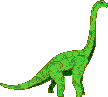 Q: What is the tallest dinosaur?
from Katie and Jay, Cleveland, OH, USA; March 26, 1998
A: Brachiosaurus is the tallest dinosaur yet found. It was about 40-50 feet tall. Ultrasauros may be taller, but only an incomplete fossil has been found (and Ultrasauros may actually be just a large Brachiosaurus). For more information on Brachiosaurus, click here.
Q: When did humans first appear
from ?; March 26, 1998
A: The first humans (homo sapiens) evolved about 200,000 year ago, during the Pleistocene Epoch. For more information on the Earth's geologic timeline, click here.
Q: How did they disappear?
from Whitney, St. Petersburg, FL, USA; March 26, 1998
A: The dinosaurs (and many other groups of animals) probably went exinct after a large asteroid hit the Earth 65 million years ago, changing the Earth's ecosystem faster than the dinosaurs could adapt to it. For more information about this mass extinction, click here or choose "Extinction" in the left-hand margin.
Q: Dear JC
Could you please send us any information you might have on the Ultrasaurus. It
was discovered by Dinosaur Jim-James Jensen in 1979 and is supposed to be one of the largest ever found.
Thank-you
absher5674
March 25, 1998
A: James A. Jensen discovered part of an incredibly huge sauropod ( a brachiosaurid) in the western USA in 1979 and named it Ultrasaurus in 1985 (meaning "Ultra lizard"). It was renamed "Ultrasauros machintoshi" because there was already another dinosaur named Ultrasaurus (a smaller, early Cretaceous sauropod found in South Korea and named by Haang Mook Kim in 1983).
Jensen's "Ultrasauros" lived during the late Jurassic period, and was one of the largest land animals ever discovered. It was a four-legged plant eater with a long, giraffe-like neck held high, a sloping back, a tiny head, and a medium-length tail. Estimates of its size vary since only a very incomplete fossil was found. Estimates vary from 82-98 feet long (25-30 m), about 52 feet (15 m) high, and a weight of 55 to 130 tons. "Ultrasauros machintoshi" may actually be a just very large example of Brachiosaurus or perhaps even Supersaurus, and not a new genus. When more fossils are found, this can be cleared up.
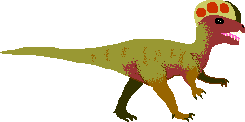 Q: In the movie Jurassic Park, the Dilophosaurus spit poison. However, I haven't discovered anything about this in research I have done. Did Dilophosaurs really spit poison or did Jurassic Park writers make up this "fact"?
from J. C., Baltimore, MD, USA; March 25, 1998
A: There is no fossil evidence that Dilophosaurus spat poison (or anything else). For an information sheet on Dilophosaurus, click here.
Q: We are a second grade class learning about dinosaurs. We want to know: What was the last living dinosaur on Earth? What was the smallest dinosaur?
from Miss Moore's class, CA, USA; March 25, 1998
A: The last dinosaurs died out in a mass extinction at the end of the Cretaceous period, 65 million years ago. Some of the dinosaur species that died out during that extinction were Tyrannosaurus rex, Protoceratops, Lambeosaurus, Pachycephalosaurus, Parasaurolophus, Maiasaura, and many, many others. The single, last dinosaur is not known.
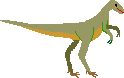 The smallest dinosaur yet discovered is Compsognathus, which was the size of a chicken. It was a tiny meat-eater that walked on two legs and lived during the Jurassic period. For more information on Compsognathus, click here.
Q: Did dinosaurs have kneecaps?
from Isaac and Justine, Gaeta, Italy; March 25, 1998
A: No
Q: how many million years did the Precambrian Period last?
from Lucy, ?; March 25, 1998
A: The Precambrian (before the Cambrian period) started when the Earth formed, about 3.9 billion years ago, and ended 540 million years ago. Scientists no longer use the term Precambrian very much because its too vague. That time period is now broken into three Eons:
- The Hadean Eon (4.6 to 3.9 billion years ago) in which the Earth's crust formed.
- The Archeozoic Eon (3.9 to 2.5 billion years ago) in which the first life formed.
- The Proterozoic Eon (2.5 billion years ago to 540 million years ago) in which multi-celled animals appeared.
For more information on the Earth's geologic history, click here.
Q: What did Sauropelta look like?
from Beth, ??; March 24, 1998
 A: Sauropelta was a 25 foot (7.6 m) long ankylosaur, an armored dinosaur with plates all over the top of its body and a row of spikes running along each side. For an information sheet on Sauropelta, click here.
Q: I'm in 2nd grade and I'm doing a report on plateosaurus. I cannot find the enemies or its protection. Could you please help me?
from Jonathan H., Elverson, PA, USA; March 24, 1998
A: Plateosaurus (meaning "flat lizard," referring to its flat teeth) was an early saurischian dinosaur, a prosauropod. It was a 26 foot (8 m) long plant eater (an herbivore) with little protection. Its head was small, and it had leaf-shaped teeth that would not be very good for defense. It could walk on two or four legs, but probably ran on all four legs. For protection from meat-eaters, it could use its speed, its large size (large for its time, the late Triassic period), its tail (which may have been used to scatter smaller predators), possibly congregation in herds, and perhaps body camouflage (to blend into the greenery).
Plateosaurus lived in western Europe and South America (Argentina) during late Triassic period, when most dinosaurs were still quite small. Large meat-eaters from that time include some Megalosaurs and Dilophosaurus. Small meat-eaters could only threaten Plateosaurus when in packs, or by attacking the very young; these include Eoraptor (see the next question), Staurikosaurus, and Herrerasaurus.
Q: I want to know about Eoraptor dinosaur?
from Jessica, ??; March 24, 1998
A: Eoraptor (meaning "dawn raptor") is the oldest dinosaur yet found, even older than Herrerasaurus. It was from the late Triassic period, roughly 228 million years ago. It was a very small, light, primitive theropod dinosaur that walked on two legs (a biped). It was less than 3 feet (1 m) long, had hollow long bones, five fingers, and was a carnivore (it ate meat). It was found in 1991 in Argentina, South America, in the same rock formation that yielded Herrerasaurus.
Q: I am a second grade teacher. My school is having a parade in May. Each classroom has a different theme. My theme is dinosaurs. Could you please give me any idea on how to create a SIMPLE costume for my students. I could use your help with anything, even something as simple as a hat.
from Robin Z., Phil., PA, USA; March 23, 1998
A: Hats made from papier-mâché molded over balloons are probably the simplest. Click here for instructions on how to make papier-mâché dinosaur hats.
Q: I am a second grade teacher and am seeking the "recipe" on how to create "dinosaur eggs" using coffee grounds. I am unsure of the exact procedure, but small model dinos are inserted into the coffee ground mixture and baked at a very low temp. If you know the specifics on this activity, I would appreciate your assistance.:)
from Sandy, Atlanta, TX, USA; March 22, 1998
A: I've never heard of this.
Q: My name is James and I'm in the 6th Grade. I have a dinosaur report due on 3/27/98. I am doing the Styracosaurus, and I just can't find any information on how they reared their young. You know, like if they took good or bad care of the babies, how they bore their young, how long it was before the young moved on, and the family structure. I also am having a little bit of trouble on their behavior. I already have the info on behavior on your site, but I can't find anything else. Like, how they interact, their response to stimuli, and their intelligence. Finally, I would please like some info on the fossils of my dinosaur... Condition, location, age, and if they're rare. Thank you very much for your time. I really appreciate it.
from James O., San Carlos, CA, USA; March 21, 1998
 A: You (or your teacher) want a lot of information that isn't known. Styracosaurus was a ceratopsian dinosaur, and it was probably a herding dinosaur (this is deduced from bonebed evidence). Like most dinosaurs, they hatched from eggs. They may have cared for their young, given their herding behavior, but to what extent is unknown. As to intelligence, the ceratopsians were in the mid-range of dinosaur brain-size/body-size; for a chart of the dinosaurs' relative intelligence, click here. Determining most of the other behavioral questions you ask about is virtually impossible from fossil evidence.
For an information sheet on Styracosaurus that answers your questions on the numbers of fossils, the location, and age of fossils (which is the age of the dinosaurs themselves), click here.
Q: What is a fossil?
from Shawna R., Port Charlotte, FL, USA; March 20, 1998
A: Click on "Fossils" in the margin to your left to get information on fossils.
Q: I am writing a school report on Tyrannosaurus Rex and cannot find who were it's enemies and where did it live. Brandon G. 2nd Grade
from Brandon G., Glenmoore, PA, USA; March 19, 1998
A: T. rex was pretty much at the top of the food chain; its enemies were tiny bugs, like bacteria and viruses which could kill it with disease. T. rex fossils have been found in the USA (in Montana, Texas, Utah, and Wyoming), Canada (Alberta and Saskatchewan), and east Asia (in Mongolia). For more information on Tyrannosaurus rex, click here.
Q: How many different types of dinosaurs were there?
from Rebecca, Hollywood, USA; March 19, 1998
A: There are about 330 described dinosaur genera, and many time that number of genera that probably existed but we haven't found yet - probably thousands. There are many times that number of dinosaur species that existed, only about 600-700 have been named, but some of these are doubtful (they may be juveniles of other species, examples of a different gender, or very large or small specimens of a known species).
Q: Did mammals live during the dino's period?
from Jaimi C., Vassalboro, Maine, USA; March 19, 1998
A: Yes, mammals and dinosaurs both evolved during the Triassic period. Some scientists think that competition from mammals may have contributed to the extinction of the dinosaurs.
Q: Could the megalodon still exist. If yes then where and how? Is the book 'Meg' acurate? Thanks
from Chris P., Stafford, Staffordshire, England; March 19, 1998
 A: Megalodon (Carcharodon megalodon) was an ancient shark, living between 5-1.6 million years ago; it is extinct. It was up to 40 feet (12 m) long, but this is only an estimate from fossil teeth that have been found. Shark fossils are rare because sharks have no bones, only cartilage, which does not fossilize well. I've never read the book "Meg."
Q: I'm trying to do a research paper on a "day in the life of dimetrodon." I know the pseudo-reptile isn't a dinosaur, but do you have any information on it? Specifically where (not when. i mean what sort of environment) it lived, what it probably ate, and how it went extinct? Most web pages and books with information on it that I have been able to find are simply rehashing stuff that's already been said. Thanks for your time.
from John, Davis, CA, USA; March 18, 1998
 A: For an information sheet on Dimetrodon, click here - I think it will answer your questions.
Q: How big was the biggest dinosaur ever in the world book of records
from Shawna R., Port Charlotte, FL, USA; March 18, 1998
A: For the biggest dinosaurs and other dinosaur extremes, click on "All About Dinosaurs" in the left-hand margin, and then on "Dinosaur Extremes" at the top of the page.
Q: What is the largest dinosaur bone that has been found by a Paleontologist?
from Michael V., Blue Earth, Minnesota, USA; March 18, 1998
A: One of the largest ever found was the shoulder blade of Supersaurus, a giant sauropod. It was over 6 feet tall and a couple of feet wide. It was found in1972 by James Jensen in western Colorado, USA. Huge sauropod femurs are also larger than people.
Q: What was the biggest man-eating dinosaur?
from Shawna R., Port Charlotte, FL, USA; March 18, 1998
A: The dinosaurs went extinct millions of years before people evolved, so there were no man-eating dinosaurs. The largest meat-eating dinosaurs were Giganotosaurus, T. rex, and perhaps Carcharodontosaurus.
Q: I need a picture of a "MEGALOSAURUS", either an artist's RENDITION, or a SKELETON, over the internet, that I can print for my kids. Can someone EMAIL me one, or advise of a web site that may have one available. I need this for my 3rd grade class. Thank you all in advance for helping me. S. Palmer
from Stephanie P., Newtown, PA, USA; March 18, 1998
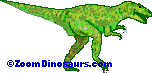 A: For a picture of Megalosaurus and an information sheet, click here.
Q: I need help on finding out what the last 3 eras were, when they occured, what era we live in, what continents fossils have been found in, what type of dinosaurs did early humans hunt for food, what type of dinos had fur, were dinos reptiles or mammals, what the definition of reptiles is, what the definition of mammals is, what ways dinos attracted mates, what does the name t-rex mean. Can you help me?
from Jackie der ..., Anchorage, AK, USA; March 17, 1998
A: To see a chart of the Earth's geologic eras, click on "Geologic Time Chart" in the margin to your left. Fossils have been found on every continent on Earth. Humans and dinosaurs did not live at the same time; people evolved millions of years after the dinosaurs went extinct. For definitions of reptiles, mammals, etc., click on the Dino/Paleo Dictionary to your left. Click here for information on T. Rex.
Q: 1.Is my dinosaur warm blooded or cold blooded?
2.Does the Allosaurus have any social?
3.What does Allosaurus mean?
4.Does it have any more information I can find? If so where can I find it?
from Lindsay, North English, Iowa, USA; March 17, 1998
A: 1. For information on warm- vs. cold-blooded dinosaurs, see the question below this one.
2. Allosaurus may have hunted in groups.
3. Allosaurus means "Different Lizard," because of its unusual vertebrae.
4. For an information sheet on Allosaurus, click here.
Q: Is the Albertosaurus a saurischian or an ornithischian?
Is the Albertosaurus endothermic or ectothermic?
What are some social traits on the Albertosaurus?
from Ashley, North English, Iowa, USA; March 17, 1998
A: Albertosaurus was a saurischian dinosaur (related to T. rex). Socially, I've never heard of the discovery of bonebeds or multiple trackways or nests of Albertosaurus, so there's no indication of herding or parental care. For more information on Albertosaurus, click here.
Whether any of the dinosaurs were endothermic or ectothermic is a matter up for debate.
- Hot-blooded animals (homeotherms) generate heat internally and maintain a relatively constant body temperature (higher than the average temperature of the environment). Examples include the mammals (including people) and birds. A related term is endothermy, meaning that an organism generates their own heat to maintain body temperatures.
- Cold-blooded animals (poikilotherms) have a body temperature that changes with external conditions. Examples include reptiles, who need to sun themselves in the morning to warm up, and then protect themselves in the midday heat. A related term is ectothermy, meaning that an organism uses external heat sources (and heat sinks) to regulate its body temperature.
The debate about whether dinosaurs were hot- or cold-blooded is quite controversial. It used to be assumed that dinosaurs were cold-blooded like their reptile ancestors. Some paleontologists have recently argued that at least some dinosaurs were fast, active, competed against hot-blooded mammals, lived in cool areas, were related to birds, and therefore were endothermic (generating their body own heat, or hot-blooded).
Dinosaurs evolved from cold-blooded animals (the reptiles) and evolved into warm-blooded animals (the birds). All dinosaurs, however, were not the same, and perhaps their physiologies differed also. The huge dinosaurs and the tiny dinosaurs might have used different heat-regulation strategies, just as they used different strategies for other aspect of living. A good argument for this is found among modern mammals. Although warm-blooded, there are some mammals (monotremes, the egg-laying mammals like the duck-billed platypus) whose metabolisms are close to being cold-blooded.
Basically, it's difficult or perhaps impossible to answer this question with today's knowledge. There are a lot of people thinking about this, and we'll be hearing a lot more about it. There's a good discussion of this topic at the UCMP museum of Paleontology.
Q: I'm doing a project for my second grade glass on Supersaurus. I would like to know where they found the fossils and when. Have they ever found a complete skeleton? Thank you.
from Mike O., McLean, VA, USA; March 17, 1998
A: Fossil bones of Supersaurus, a huge diplodocid dinosaur, have been found in western Colorado, USA. It was first discovered in 1972 by the American paleontologist James A. Jensen. Only a few bones have been found, including huge neck bones and a gigantic shoulderblade taller than a man.
Q: Is the megalosaurus a saurischian or a ornithischian?
from Dana, North English, Iowa, USA; March 17, 1998
A: Megalosaurus was a saurischian dinosaur.
Q: Who invented the term dinosaurs?
from Noelle L., Port Charlotte, FL, USA; March 17, 1998
A: Although dinosaur fossils have been known since 1818, the term dinosaur ("deinos" means terrifying; "sauros" means lizard) was coined by the English anatomist Sir Richard Owen in 1842. The only three dinosaurs known at the time were Megalosaurus, Iguanodon, and Hylaeosaurus, large dinosaurs.
Q: How many teeth does a Tyrannosaurus have? How did they really die?
from Angel V., Turlock, CA, USA; March 16, 1998
A: T. rex had up to 60 teeth. T. rex, along with a lot of the late dinosaurs, died during the K-T extinction, 65 million years ago. For more information on mass extinction, click here.
Q: I have to do a report on Thecodontosaurus for my class. I am unable to find any information. Could you help me? Maybe guide me to some information. I am in second grade. Thank you!
from Jared, Burlington, WI, USA; March 16, 1998
A: Thecodontosaurus (meaning "socket-toothed lizard") was a very early dinosaur from the late Triassic period. This was around the time that the dinosaurs were just starting to appear. Thecodontosaurus ate plants and was about 7 feet (2.1 m) long. It had a small head, large thumb claws, long legs, a relatively short neck, short arms than legs, and a long tail. It could probably walk on two or four legs, perhaps grazing and walking on all fours, but running on two legs. It had blunt teeth with serrated edges. It had four toes on each leg and five fingers on each hand.
Fossils have been found in England (near Bristol), which was probably dry and desert-like when Thecodontosaurus lived. Thecodontosaurus is classified as a saurischian (a "lizard-hipped" dinosaur), a sauropodomorpha (usually quadrupedal herbivores), a prosauropod (an early, dead-end branch of the sauropodamorphas), and an Anchisaurid (the earliest prosauropods).
Q: I was wondering if you could please send me some pics. and some info of a hypsilophodon. It would be greatly appreciated.
from Joey and Jonny T.; March 16, 1998
A: Your e-mail address didn't work! All the pictures and information about Hypsilophodon are online, just click here.
Q: What is a Bactrosaurus and what does it look like?
from Trisha B., Phillipsburg, NJ, USA; March 16, 1998
A: Bactrosaurus was a flat-headed, duck-billed dinosaur (a lambeosaurine hadrosaur) with no crest. It was an herbivore from the late Cretaceous period. It walked on two legs and was about
13-20 feet (4-6 m) long. Like other duck-bills, its beak had no teeth in front, but many cheek teeth for chewing plant fiber. It probably looked a lot like Lambeosaurus, but was smaller and had no crest.
Q: I am doing a report on the plesiosaurus, but have not found how they protect themselves. Do you know?
from Scott M., Colchester, VT, USA; March 16, 1998
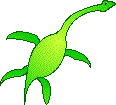 A: Plesiosaurus was a marine lizard about 16 feet long that lived during the Jurassic period; it was not a dinosaur. It had very little protection from predators. Its best protection was its teeth and its speed in the water. For more information on Plesiosaurs, the family that Plesiosaurus belonged to, click here.
Q: who first proposed the theory of continental drift?
from ???; March 16, 1998
A: In 1912, the German geologist and meteorologist Alfred Wegener first proposed the theory of continental drift, which states that parts of the Earth's crust slowly drift atop a liquid core. For more information, click here.
Q: Is there a Dinosaur big than Supersaurus?
from Anthony M., Condor, NC, USA; March 14, 1998
A: Supersaurus may be the biggest dinosaur yet found. Click here for more huge dinosaurs.
Q: In my summer school program, they told us about a dinosaur that spits, or a spitosauraus. Is there such a thing? Thank you!!
from Mark, Woodinville, WA, USA; March 13, 1998
A: I've never heard of it. Also, I'm not sure how the fossil record would indicate that an extinct animal tended to spit.
Q: Were opossums in there present state when the dinosaurs were living? Back in the prehistoric time.
from ??; March 13, 1998
 A: Very primitive marsupials (the ancestors of today's opossums) evolved during the Cretaceous period, between 100 and 75 million years ago. This was towards the end of the Mesozoic Era (the dinosaur's reign); the dinosaurs went extinct 65 million years ago. Modern-day opossums evolved much later.
Q: Do you have any new information concerning the dinosaur called "Deinocheiros"? Was it a carnivore? Did it belong to the raptors or dromaeoaurs or any other carnivors of this normally small individuals? Deinocheiros had extraordinary big arms, and nothing more was found so far, am I right? Is there any progress in science
concerning this species? It would be nice to hear from you.
Thanx a lot and best wishes. Axel
from schuch, nürnberg, bavaria, germany; March 12, 1998
A: Deinocheirus (meaning "terrible hand") was a bipedal carnivore (meat-eater) from the late Cretaceous period. It is classified as a saurischian (lizard-hipped dinosaurs), a theropod, a coelurosaur, and an ornithomimid (bird mimic). It was probably not a dromeosaur (the "raptors," another subgroup of the coelurosaurs). Note: the classification of the dinosaurs is changing all the time, especially with animals like Deinocheirus, whose fossils are terribly incomplete.
As you wrote, only the arms, hands, and claws of Deinocheirus have been found (in the Gobi desert of Mongolia in 1965). The arms are 8 feet (2.4 m) long and have three fingers with long, hook-like claws, 8-12 inches (20-30 cm) long. The hands alone were 2 feet (60 cm) long. Deinocheirus was probably one of the most deadly dinosaurs of the late Cretaceous period. It may have been larger that T. rex.
Q: Is there really a flying dinosaur? This second grade class is not convinced that their is no flying dinosaurs!
from Second Grade Class, Blue Earth, MN, USA; March 12, 1998
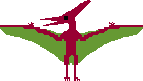 A: There were no flying dinosaurs but there were a lot of flying reptiles during the time of the dinosaurs. These flying reptiles were called pterosaurs; examples include Pteranodon and Quetzalocoatlus. They went extinct along with the dinosaurs about 65 million years ago. For more information on pterosaurs, click here.
Q: Our class is researching dinosaurs. We want to know how you can tell if a dinosaur is a plant eater or meat eater. Also, how does a T-Rex attack?
from Mrs. Anderson's class, Ripley Elementary, WV, USA; March 12, 1998
A: Plant eaters and meat eaters are built very differently. Each has specialized teeth, digestive systems, defensive and/or offensive structures and strategies.
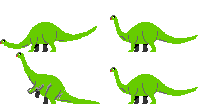 Plant eaters (herbiores) usually have blunt teeth that are good for stripping vegetation (leaves, twigs, etc.). Some also have flat teeth for grinding tough plant fibers. Many herbivores have cheek pouches in which they can store food for a while. Plant eaters also usually have larger digestive systems that are needed to digest the tough fibers. Sometimes these dinosaurs swallow rocks to help grind up the fibers in their guts. Some (like Ankylosaurus) even had fermentation chambers, where the fibers were dissolved.
 Meat eaters (carnivores) need to have some way to get meat. Carnivorous dinosaurs usually had long, strong legs so that they could run fast in order to catch their prey. They also needed big, strong jaws, sharp teeth and deadly claws that could kill and then tear apart the prey. Good eyesight, a keen sense of smell, and a large brain to plan hunting strategies are also very important for successful hunting. Many of the carnivores (like Deinonychus) may have hunted in packs, so social cooperation was necessary for a good hunt. Scavengers (animals that eat meat that they did not kill themselves) need very sharp teeth and strong jaws for tearing into the meat and breaking the bones for nutritious bone marrow.
T. rex probably attacked by chasing its prey and taking huge bites of flesh with its enormous jaws and slashing the prey with its large toe claws. The loss of blood would kill the prey pretty quickly. T. rex's tiny arms were probably not used in the kill. Click here for more information on T. Rex.
Q: Where did the dinosaur Velociraptor live when it was alive, and what kind of envirnment was it?
from Jane F., Columbia, NJ, USA; March 11, 1998
A: Velociraptor fossils have been found in Mongolia, China, and Russia. Velociraptor lived during the Cretaceous period, a time that was warmer than it is now, but also a time of increased volcanic activity and continental movement; the continents had almost taken on their modern-day form. For more information on Velociraptor, click here.
Q: Were there more herbivores or carnivores?
from Mrs. Benjamin, Colchester, VT, USA; March 11, 1998
A: There were many more herbivores. In any food chain, there need to be more organisms at the lower levels of the chain, so the number of carnivores is less than the number of herbivores which is less than the number of plants.
Q: I am in second grade and am doing a report on the Megalosaurus. I need to know what this type of dinosaur ate, and where they lived. I also need to know why it became extinct. I hope you can help me. Thank you very much.
from Casey C., Clearwater, FL, USA; March 10, 1998
A: Megalosaurus, meaning "great lizard," was a large theropod, a two-legged meat eater who lived from the early Jurassic through the early Cretaceous periods. It was about 30 feet (9 m) long and weighed about 1 ton. It had a big head, short neck, long, powerful legs, short arms, a long tail, and claws on fingers and toes. Fossils have been found in Europe (in France and England).
It went extinct long before the huge K-T mass extinction; it died out in a typical background extinction. The Cretaceous was a time of great environmental change; there was a lot of volcanic activity, continents were moving, and a lot of new species were competing with old ones. The inability to adapt to change quickly is generally the cause of extinctions.
Q: Our class is studying dinosaurs and we were wondering if any of the dinosaurs ate both meat and plants?
Thank you!
from Caitlyn W., Colchester, Vermont, USA; March 10, 1998
A: Most dinosaurs were herbivores (plant eaters), some were carnivores (meat eaters) and only a very rare few were omnivores (eating both plants and animals). Some examples of omnivores are Ornithomimus and Oviraptor, which ate plants, eggs, insects, etc. Also, most herbivores are "accidental omnivores" in that when they are eating plants, they also ingest a lot of insects and small animals.
Q: What is a Rhampherincus and how do you spell it correctly?
from Ted C., ?; March 10, 1998
A: Rhamphorhynchus was a small, flying reptile with a long tail and a long, toothed beak. It was not a dinosaur, but a pterosaur. Rhamphorhynchus lived during the late Jurassic in Europe
and Africa.
Q: I would appreciate your help with the following:
1. What Dinosaur had a duck bill?
2. What do you call people who study the rocks of the earth's crust
3. Which Dinosaur was named a lizard because it had teeth that looked like lizards teeth.
Thank you very much for your help, this site has been really great in helping me do my assignment.
from Daniel N., Edensor Park, NSW, Australia; March 9, 1998
A: 1. The Hadrosaurs were the family of "Duck-billed" dinosaurs - they had flat, toothless, horny beaks, powerful jaws with cheek teeth and cheek pouches, and were vegetarians (herbivores). The "duck bills" included Maiasaura, Parasaurolophus, Lambeosaurus, Hadrosaurus, and many others.
2. Geologists
3. I don't know, but Iguanodon's teeth resembled an Iguana's teeth, hence its name.
Q: Hi, I'm sorry if I have caused any inconveniences previously, but I would like you to help me answer the following questions about Apatosaurus:
To which group did Apatosaurus belong to?What was the climate like during the existence of the Apatosaurus?
from Shina T., Denver, CO, USA; March 9, 1998
A: Apatosaurus (which used to be known as Brontosaurus) was a huge herbivorous dinosaur. It was a saurischian ("lizard hipped" dinosaurs, the ancestors of birds), a sauropodomorph (long-necked, long-tailed plant-eaters who walked on four legs), a sauropod (very large herbivores), and a member of the Family Diplodocidae (peg-toothed sauropods, which included Diplodocus, Seismosaurus, Supersaurus, and others).
Apatosaurus lived during the late Jurassic Period, about 157-146 million years ago. This was a time when the Earth was very warm - there was no ice at the North and South poles, and even the winters were mild.
Click here for an information sheet on Apatosaurus.
Q: Where did the Lesothosaurus live and what was it like?
from Kevin M., ??; March 8, 1998
 A: Lesothosaurus was one of the earliest dinosaurs yet found, and dates from the early Jurassic period. It walked on two long legs, had short arms, a long tail, a small head, and was small, about 3 feet (1 m) long. It was an herbivore (plant-eater) and a fast, agile runner. It was an ornithischian dinosaur (the "bird-hipped" dinosaurs), an ornithopod (bipedal dinos with no body armor), and belonged to the family Fabrosauridae (the earliest ornithopods). Two Lesothosaurus fossils were found together in Lesotho, South Africa.
Q: I am doing a report on dinosaurs and was hoping I could get the weight, length, and height of both the Plesiosaurus and the Nothosaurus. Thank you.
from Steve, Billings, MT, USA; March 8, 1998
A: Plesiosaurus and Nothosaurus are extinct marine reptiles, but not dinosaurs.
There were several species of Plesiosaurus, which was the earliest known Plesiosaur. Plesiosaurs were early Jurassic marine reptiles with flippers. Plesiosaurus was about 7.5 feet (2.3 m) long. Click here for more info on Plesiosaurus and other Plesiosaurs.
 Nothosaurus was about 10 feet (3 m) long. Click here for more info on Nothosaurus and other Nothosaurs. I can't find any information on their weights and I'm not sure how you'd figure out a height measurement for these seal-like animals.
Q: Why have extinctions occured throughout the history of the Earth.
from ???; March 8, 1998
A: The environment and the organisms on the Earth are continually changing. Those species that cannot adapt or compete with other organisms go extinct. For more information on extinctions, click here.
Q: What is the biggest dinosaur found.
from Jocelin O., Houston, TX, USA; March 7, 1998
A: The giant sauropods from the Jurassic period were the biggest. For more details, click here for a page on dinosaur extremes.
Q: Which type of dinosaur was the meanest and most aggresive that lived in Arizona? Thanks, Zachary G. age 6 Gilbert AZ
from Zachary G., Gilbert, Arizona, USA; March 6, 1998
A: Dinosaurs weren't mean. The meat eaters only killed other animals in order to survive. Dinosaurs found in Arizona include the meat eaters: Dilophosaurus (a 20 foot long, crested meat eater), Eubrontes (a heavy, 20 foot long carnivore), Segisaurus (a very small, speedy meat eater), and Syntarsus (a small, primitive meat eater). Plant eaters from Arizona include: Ammosaurus ( a prosauropod, a very early, plant-eating dinosaur), Anchisaurus (another prosauropod), Anomoepus (an ornithischian - a vegetarian dinosaur), Chindesaurus (a small prosaurupod), Navahopus (another prosauropod), and Scutellosaurus (a small, primitive armored plant eater).
Q: I have two questions,1)How many species were there?
2)Do you have any info on the dryosaurus?
from Jonathan A., Hillsborough, N.B., CA; March 5, 1998
A: 1) There are about 330 described dinosaur genera, and many time that number of genera that probably existed but we haven't found yet - probably thousands. There are many times that number of dinosaur species that existed, only about 600-700 have been named, but some of these are doubtful (they may be juveniles of other species, examples of a different gender, or very large or small specimens of a known species).
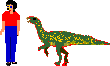 2) Dryosaurus (meaning "oak lizard") was a fast moving, agile, herbivorous (plant eater) dinosaur. It was about 10 feet (3 m) long and 4.5 feet (1.4 m) tall. It had large eyes, long, thin legs with three toes, shorter arms with five long fingers, a horny beak and cheek teeth. It may have stored food in its cheeks. It had a long neck and a stiff tail used for balance. It laid eggs and may have travelled in herds. There may have been some parental care for the young.
Dryosaurus lived during the late Jurassic to early Cretaceous periods. Its contemporaries were Apatosaurus, Diplodocus, Brachiosaurus, Coelurus, Allosaurus, Stegosaurus, and Ceratosaurus.
It is a Hypsilophodontid (which includes the smaller Hypsilophodon, Othnielia, Tenontosaurus, Parkosaurus, and Thescelosaurus). Fossils have been found in western North America and Africa.
Q: How many feet tall is the Dimetrodon? I am in second grade and doing a report on him.
from Alex D., Boise, ID, USA; March 4, 1998
A: Dimetrodon (not a dinosaur but a pelycosaur) was about11.5 feet (3.5 m) long and 4 -5 feet (1.2-1.5 m) tall; most of the height was the sail. Click here for an information sheet on Dimetrodon.
Q: what information can you give us about gizzard rocks in relationship to dinosaurs.
from First grade class, Tahlequah, OK, Cherokee; March 3, 1998
A: Many plant-eating dinosaurs swallowed small rocks that stayed in their stomachs. These rocks (called gizzard stones or gastroliths) tumbled around in their stomachs, helping to grind up the tough food (leaves, twigs, pine needle, etc.). Some dinosaurs that used gizzard stones were: Apatosaurus, Diplodocus, and Massospondylus.
Q: PLEASE HELP !!!!! I HAVE A REPORT DUE ON THE SAUROPELTA DINOSAUR.
I CAN NOT FIND ANY PICTURE OF THIS DINOSAUR AND VERY FEW
ARTICLES . I HAVE SEARCHED THE INTERNET AND THE LOCAL LIBRARY.
CAN YOU HELP THANKS, MICHAEL, GRADE 3
from Michael; March 2, 1998
A: Sauropelta was an armored dinosaur from the early Cretaceous period. It looked a lot like its relative Ankylosaurus, but didn't have the bony nodes at the end of its tail or horns on its head. It was about 25 feet long and weighed over 3 tons. Like Ankylosaurus, it had horn-covered plates all over its body embedded in its skin (except on its underbelly). It also had a row of sharp spikes going along each side of its body. It was an herbivore (it ate plants) and moved very slowly on four short legs. Fossils have been found in Montana, USA.
Q: Where have fossils of T-rex being found in North America?
from Zachary, Aurora, Colorado, USA; March 2, 1998
Q:During what period of geologic time did Tyrannosaurus exist?
from Oluwashina Tomori, Denver, CO, USA; March 2, 1998
Q:During what period of geologic time did the T-rex exist?
from Shina, Denver, CO, USA; Feb. 27, 1998
A: Tyrannosaurus rex lived during the late Cretaceous period, about 85 to 65 million years ago. Fossils have been found in the western USA (in Montana, Texas, Utah, and Wyoming), Canada (Alberta and Saskatchewan), and Asia (Mongolia).
Click here for an information sheet on T. rex.
Q: Please, send me all the facts about Gigantosaurus. Nikola
from Nikola Krstic, Belgrade, Serbia, Yugoslavia; March 2, 1998
Q: What time period was the Giganotosaurus from?
from Colleen, Pennsville, NJ, USA; Feb. 28, 1998
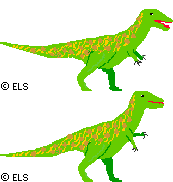 A: Giganotosaurus lived during the mid-Cretaceous period, about 100 million years ago. For more information on Giganotosaurus, click here.
Return to the top of the page.
Enchanted Learning®
Over 35,000 Web Pages
Sample Pages for Prospective Subscribers, or click below
Click to read our Privacy Policy
Enchanted Learning Search
|
Search the Enchanted Learning website for:
|
Advertisement.
Advertisement.
Copyright ©1997-2018
EnchantedLearning.com ------ How to cite a web page

