




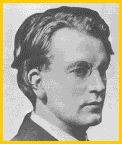
 John Logie Baird (1888-1946) was a Scottish inventor and engineer who was a pioneer in the development of mechanical television. In 1924, Baird televised objects in outline. In 1925, he televised human faces. In 1926, Baird was the first person to televise pictures of objects in motion. In 1930, Baird made the first public broadcast of a TV show, from his studio to the London Coliseum Cinema; the screen consisted of a 6-ft by 3-ft array of 2,100 tiny flashlamp bulbs. Baird developed a color television in 1928, and a stereo television in 1946. Baird’s mechanical television was usurped by electronic television, which he also worked on.
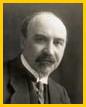
BaekelandLeo Hendrik Baekeland (November 14, 1863 - February 23, 1944) was a Belgian-born American chemist who invented Velox photographic paper (1893) and Bakelite (1907), an inexpensive, nonflammable, versatile, and very popular plastic.

Bakelite (also called catalin) is a plastic, a dense synthetic polymer (a phenolic resin) that was used to make jewelry, game pieces, engine parts, radio boxes, switches, and many, many other objects. Bakelite was the first industrial thermoset plastic (a material that does not change its shape after being mixed and heated). Bakelite plastic is made from carbolic acid (phenol) and formaldehyde, which are mixed, heated, and then either molded or extruded into the desired shape.
Bakelite was patented in 1907 by the Belgian-born American chemist Leo Hendrik Baekeland (November 14, 1863 - February 23, 1944). The Nobel Prize winning German chemist Adolf von Baeyer had experimented with this material in 1872, but did not complete its development or see its potential.
Baekeland operated the General Bakelite Company from 1911 to 1939 (in Perth Amboy, N.J., USA), and produced up to about 200,000 tons of Bakelite annually. Bakelite replaced the very flammable celluloid plastic that had been so popular. The bracelet above is made of “butterscotch” bakelite.
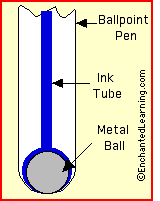
The first non-leaking ballpoint pen was invented in 1935 by the Hungarian brothers Lazlo and Georg Biro. Lazlo was a chemist and Georg was a newspaper editor.
A ballpoint marker had been invented much earlier (in 1888 by John Loud, an American leather tanner, who used the device for marking leather) but Loud’s marker leaked, making it impractical for everyday use. A new type of ink had to be developed; this is what the Biro brothers did. The brothers patented their invention and then opened the first ballpoint manufacturing plant in Argentina, South America.

Bandages for wounds had been around since ancient times, but an easy-to-use dressing with an adhesive was invented by Earle Dickson (a cotton buyer at the Johnson & Johnson company). Dickson perfected the BAND-AID® in 1920, making a small, sterile adhesive bandage for home use. Dickson invented the BAND-AID® for his wife, who had many kitchen accidents and needed an easy-to-use wound dressing. Dickson was rewarded by the Johnson & Johnson company by being made a vice-president of the company.

Bar codes (also called Universal Product Codes or UPC’s) are small, coded labels that contain information about the item they are attached to; the information is contained in a numerical code, usually containing 12 digits. UPC’s are easily scanned by laser beams. UPC’s are used on many things, including most items for sale in stores, library books, inventory items, many packages and pieces of luggage being shipped, railroad cars, etc. The UPC may contain coded information about the item, its manufacturer, place of origin, destination, the owner, or other data. The first “bullseye code” was invented by Norman Joseph Woodland and Bernard Silver, from work which they began in 1948. On October 20, 1949, they patented their bullseye code (a series of concentric circles that were scannable from all directions, using regular light). Woodland and Silver patented a new UPC in October 1952; the UPC was also improved and adapted by David J. Collins in the late 1950’s (to track railroad cars). UPC’s were first used in grocery stores in the early 1970’s.
Christiaan Neethling Barnard (1923- 2001) was a South African heart surgeon who developed surgical procedures for organ transplants, invented new heart valves, and performed the first human heart transplant (on Dec. 3, 1967, in a five-hour operation with a team of 20 surgeons). The 55-year-old Louis Washkansky received the heart transplant; Washkansky lived for only 18 days after the operation, dying from pneumonia (his immune system had been weakened by drugs designed to suppress the rejection of the new heart). The donor of the heart was a woman who had been fatally injured in a car crash. Barnard performed more successful transplants later in his career; some of his later transplant recipients survived for years. Barnard was the head of the cardiac unit at Groote Schuur Hospital until he retired in 1983
A barometer is a device that measures air (barometric) pressure. It measures the weight of the column of air that extends from the instrument to the top of the atmosphere. There are two types of barometers commonly used today, mercury and aneroid (meaning “fluidless”). Earlier water barometers (also known as “storm glasses”) date from the 17th century. The mercury barometer was invented by the Italian physicist Evangelista Torricelli (1608 - 1647), a pupil of Galileo, in 1643. Torricelli inverted a glass tube filled with mercury into another container of mercury; the mercury in the tube “weighs” the air in the atmosphere above the tube. The aneroid barometer (using a spring balance instead of a liquid) was invented by the French scientist Lucien Vidie in 1843.
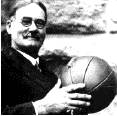
 The game of basketball was invented by James Naismith (1861-1939). Naismith was a Canadian physical education instructor who invented the game in 1891 so that his students could participate in sports during the winter. In his original game, which he developed while at the Springfield, Massachusetts YMCA (Young Men’s Christian Association), Naismith used a soccer ball which was thrown into peach baskets (with the basket bottoms intact). The first public basketball game was in Springfield, MA, USA, on March 11, 1892. Basketball was first played at the Olympics in Berlin Germany in 1936 (America won the gold medal, and Naismith was there).
A bathysphere is a pressurized metal sphere that allows people to go deep in the ocean, to depths at which diving unaided is impossible. This hollow cast iron sphere with very thick walls is lowered and raised from a ship using a steel cable. The bathysphere was invented by William Beebe and Otis Barton (around 1930). William Beebe (1877 - 1962), an American naturalist and undersea explorer, tested the bathysphere in 1930, going down to 1426 feet in a 4‘9” (1.45 m) diameter bathysphere. Beebe and Otis Barton descended about 3,000 ft (914 m) feet in a larger bathysphere in 1934. They descended off the coast of Nonsuch Island, Bermuda in the Atlantic Ocean. During the dive, they communicated with the surface via telephone.

A battery is a device that converts chemical energy into electrical energy. Each battery has two electrodes, an anode (the positive end) and a cathode (the negative end). An electrical circuit runs between these two electrodes, going through a chemical called an electrolyte (which can be either liquid or solid). This unit consisting of two electrodes is called a cell (often called a voltaic cell or pile). Batteries are used to power many devices and make the spark that starts a gasoline engine.
Alessandro Volta was an Italian physicist invented the first chemical battery in 1800.
Storage batteries are lead-based batteries that can be recharged. In 1859, the French physicist Gaston Plante (1834-1889) invented a battery made from two lead plates joined by a wire and immersed in a sulfuric acid electrolyte; this was the first storage battery.
The dry cell is a an improved voltaic cell with a cylindrical zinc shell (the zinc acts as both the cathode and the container) that is lined with an ammonium chloride (the electrolyte) saturated material (and not a liquid). The dry cell battery was developed in the 1870s-1870s by Georges Leclanche of France, who used an electrolyte in the form of a paste.
Edison batteries (also called alkaline batteries) are an improved type of storage battery developed by Thomas Edison. These batteries have an alkaline electrolyte, and not an acid.
For more information on the battery, click here.

Martin Behaim (1459-1537) was a German mapmaker, navigator, and merchant. Behaim made the earliest globe, called the “Nürnberg Terrestrial Globe”. It was made during the years 1490-1492; the painter Georg Glockendon helped in the project. Behaim had previously sailed to Portugal as a merchant (in 1480). He had advised King John II on matters concerning navigation. He accompanied the Portuguese explorer Diogo Cam (Cão) on a 1485-1486 voyage to the coast of West Africa; during this trip, the mouth of the Congo River was discovered. After returning to Nürnberg in 1490, Behaim began construction of his globe (which was very inaccurate as compared to other maps from that time, even in the areas in which Behaim had sailed). It was once thought that Behaim’s maps might have influenced Columbus and Magellan; this is now discounted. Behaim may have also developed an astrolabe. Behaim’s globe is now in the German National Museum in Nürnberg.

Alexander Graham Bell (March 3, 1847, Edinburgh, Scotland - August 2, 1922, Baddek, Nova Scotia) invented the telephone (with Thomas Watson) in 1876. Bell also improved Thomas Edison’s phonograph. Bell invented the multiple telegraph (1875), the hydroairplane, the photo-sensitive selenium cell (the photophone, a wireless phone, developed with Sumner Tainter), and new techniques for teaching the deaf to speak. In 1882, Bell and his father-in-law, Gardiner Hubbard, bought and re-organized the journal “Science.” Bell, Hubbard and others founded the National Geographic Society in 1888; Bell was the President of the National Geographic Society from 1898 to 1903.
Henry Bell (1767-1830) was a Scottish engineer and inventor who built a steam-powered boat in 1812. His 12-foot (3.5-meter) steamboat, called the Comet, was the first commercially successful steamship in Europe. This boat regularly sailed between Greenock and Glasgow (Scotland) along the River Clyde. The Comet was the beginning of a revolution in navigation.

Tim Berners-Lee (1955, London, England - ) invented the World Wide Web. His first version of the Web was a program named “Enquire,” short for “Enquire Within Upon Everything”. At the time, Berners-Lee was working at CERN, the European Particle Physics Laboratory located in Geneva, Switzerland. He invented the system as a way of sharing scientific data (and other information) around the world, using the Internet, a world-wide network of computers, and hypertext documents. He wrote the language HTML (HyperText Mark-up Language), the basic language for the Web, and devised URL’s (universal resource locators) to designate the location of each web page. HTTP (HyperText Transfer Protocol) was his set of rules for linking to pages on the Web. After he wrote the first browser in 1990, the World Wide Web was up and going. Its growth was (and still is) phenomenal, and has changed the world, making information more accessible than ever before in history. Berners-Lee is now a Principal Research Scientist at the Laboratory for Computer Science at the MIT (Massachusetts Institute of Technology, in Cambridge, Massachusett, USA) and the Director of the W3 Consortium.
Dr. Solomon A. Berson (1919-1972) and Dr. Rosalyn Sussman Yalow (1921- ) co-invented the radioimmunoassay (RIA) in 1959. The radioimmunoassay is a method of chemically analyzing human blood and tissue that is used diagnose illness (like diabetes). RIA revolutionized diagnoses because it used only a tiny sample of blood or tissue and is a relatively inexpensive and simple test to perform. Blood banks use RIA to screen blood; RIA is used to detect drug use, high blood pressure, infertility, and many other conditions and diseases. For inventing RIA, Yalow won the Nobel Prize in Medicine in 1977 (Yalow accepted for Berson, who died in 1972). Yalow and Berson did not patent the RIA; instead they allowed the common use of RIA to benefit human health.

The earliest bicycle was a wooden scooter-like contraption called a celerifere; it was invented about 1790 by Comte Mede de Sivrac of France. In 1816, Baron Karl von Drais de Sauerbrun, of Germany, invented a model with a steering bar attached to the front wheel, which he called a Draisienne. It has two wheels (of the same size), and the rider sat between the two wheels, but there were no pedals; to move, you had to propel the bicycle forward using your feet (a bit like a scooter). He exhibited his bicycle in Paris on April 6, 1818.

 Benjamin Franklin invented bifocal glasses in the 1700s. He was nearsighted and had also become farsighted in his middle age. Tired of switching between two pairs of glasses, Franklin cut the lenses of each pair of glasses horizontally, making a single pair of glasses that focused at both near regions (the bottom half of the lenses) and far regions (the top half of the lenses). This new type of glasses let people read and see far away; they are still in use today.

Katherine J. Blodgett (1898-1979) was an American physicist and inventor who invented a micro-thin barium stearate film that makes glass completely nonreflective and “invisible” (patent #2,220,660, March 16, 1938). Blodgett’s invention has been used in eyeglasses, camera lenses, telescopes, microscopes, periscopes, and projector lenses. Blodgett also invented a gauge that measured the thickness of this type of coating (which can be only a few molecules thick), called a “color gauge.”
The idea of a blood bank was pioneered by Dr. Charles Richard Drew (1904-1950). Dr. Drew was an American medical doctor and surgeon who started the idea of a blood bank and a system for the long term preservation of blood plasma (he found that plasma kept longer than whole blood). His ideas revolutionized the medical profession and saved many, many lives. Dr. Drew set up and operated the blood plasma bank at the Presbyterian Hospital in New York City, NY. Drew’s project was the model for the Red Cross’ system of blood banks, of which he became the first director.

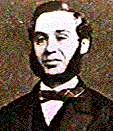 Levi Strauss (1829-1902) was an entrepreneur who invented and marketed blue jeans. Trained as a tailor in Buttenheim, Bavaria, Germany, Strauss went to San Francisco, USA from New York in 1853. Strauss sold dry goods, including tents and linens to the 49ers (the people who came to the California gold rush, which began in 1849). In 1873, Strauss and Jacob Davis, a Nevada tailor, patented the idea (devised by Davis) of using copper rivets at the stress points of sturdy work pants. Early levis, called “waist overalls,” came in a brown canvas duck fabric and a heavy blue denim fabric. The duck fabric pants were not very successful, so were dropped early on. His business became extremely successful (and still is), revolutionizing the apparel industry.
Cellophane is a thin, transparent, waterproof, protective film that is used in many types of packaging. It was invented in 1908 by Jacques Edwin Brandenberger, a Swiss chemist. He had originally intended cellophane to be bonded onto fabric to make a waterproof textile, but the new cloth was brittle and not useful. Cellophane proved very useful all alone as a packaging material. Chemists at the Dupont company (who later bought the rights to cellophane) made cellophane waterproof in 1927.

Braille is a coded system of raised dots that are used by the blind to read. Louis Braille (1809-1852) invented this system in 1829. Braille published “The Method of Writing Words, Music, and Plain Song by Means of Dots, for Use by the Blind and Arranged by Them,” and his method is still in use around the world today.
Louis Braille (Jan. 4, 1809-Jan. 6, 1852) improved a coded system of raised dots used by the blind to read. He was blinded as a child, and invented his extraordinary system in his early teens. In 1829, Braille published “The Method of Writing Words, Music, and Plain Song by Means of Dots, for Use by the Blind and Arranged by Them.” His method, called Braille, is still in use around the world today. Louis Braille is buried in the Pantheon in Paris, as a French national hero. For a worksheet on Braille, click here.
The Hall Braille typewriter (also called a Braillewriter or Brailler) was invented in 1892 by Frank Haven Hall. Hall was the Superintendent of the Illinois Institution for the Blind. The Hall Braille typewriter was manufactured by the Harrison & Seifried company in Chicago, Illinois, USA. Hall introduced his invention on May 27, 1892, at Jacksonville, Illinois. It types raised Braille dots onto paper.

The automatic commercial bread slicer was invented in 1927 by Otto Frederick Rohwedder from Iowa, USA (Rohwedder had worked on his machine since 1912). His machine both sliced and wrapped a loaf of bread. In 1928, the bread slicer was improved by Gustav Papendick, a baker from St. Louis, Missouri.

Bubblegum was invented by Frank Henry Fleer in 1906, but was not successful; the formulation of Fleer’s “Blibber-Blubber,” was too sticky. In 1928, Walter E. Diemer invented a superior formulation for bubble gum, which he called ” Double Bubble.”
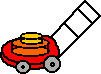
The first lawn mower was invented in 1830 by Edwin Beard Budding. Budding (1795-1846) was an engineer from Stroud, Gloucestershire, England. His reel mower was a set of blades set in a cylinder on two wheels. When you push the lawn mower, the cylinder rotates, and the blades cut the grass. Budding patented his lawn mower on August 31, 1830. Before his invention, a scythe was used (or sheep or other grazing animals were allowed to graze on the grass). The first reel lawn mower patent in the US (January 12, 1868) was granted to Amariah M. Hills, who formed the Archimedean Lawn Mower Co.
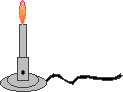
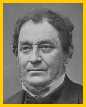 The laboratory Bunsen burner was invented by Robert Wilhelm Bunsen in 1855. Bunsen (1811-1899) was a German chemist and teacher. He invented the Bunsen burner for his research in isolating chemical substances - it has a high-intensity, non-luminous flame that does not interfere with the colored flame emitted by chemicals being tested.

Luther Burbank (1849-1926) was an American plant breeder who developed over 800 new strains of plants, including many popular varieties of potato, plums, prunes, berries, trees, and flowers. One of his greatest inventions was the Russet Burbank potato (also called the Idaho potato), which he developed in 1871. This blight-resistant potato helped Ireland recover from its devastating potato famine of 1840-60. Burbank also developed the Flaming Gold nectarine, the Santa Rosa plum, and the Shasta daisy. Burbank was raised on a farm and only went to elementary school; he was self-educated. Burbank applied the works of Charles Darwin to plants. Of Darwin’s The Variation of Animals and Plants under Domestication, Burbank said, “It opened up a new world to me.”

The word game Scrabble® was developed by Alfred Mosher Butts in 1948. James Brunot did some rearranging of the squares and simplified the rules. A copyright was granted on December 1, 1948. Alfred Butts had been an architect, but lost his job in 1931 (during the depression). He then began developing games, including Lexico, Criss-Crosswords, and them Scrabble®. After about 4 years of paltry sales, Scrabble® became a hit.