
|
| You might also like: | Insect Math-Code Game #10 | Wasp Printout | Cicada Printout | Cicada Printout (simplel version) | Assassin Bug Coloring | Today's featured page: Art Activities and Projects for Students |
| Go to the Quiz Insect Printouts |
Indian Walkingstick Laboratory Stick Insect |
Animal Printouts Label Me! Printouts |
Camouflage by Plant Mimicry: The walkingstick is well-camouflaged in its environment, since it looks like a twig. Plant mimicry also occurs in its eggs; the eggs have hard shells and look much like tiny brown seeds.
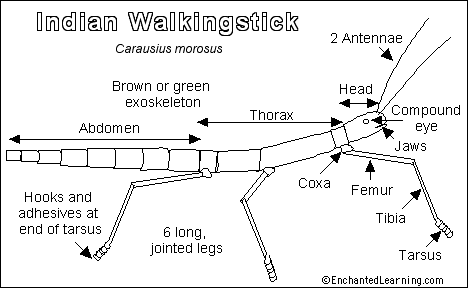
Anatomy: Like all insects, the Walkingsticks have a three-part body (head, thorax and abdomen), six jointed legs, two pairs of wings, and two antennae. Their body is covered with a hard exoskeleton. Walkingsticks breathe through a series of holes called spiracles; they are located along the sides of the body. Indian Walkingsticks are brown or green. The body is long (up to 8 cm for females, 6 cm for males) and thin (with a diameter of about 5 mm).
Metamorphosis: Indian Walkingsticks are often parthenogenetic; females can lay unfertilized eggs that hatch into females who can also lay unfertilized eggs. Walkingsticks undergo simple (or incomplete) metamorphosis; eggs hatch into nymphs, which look like little adults without wings or reproductive organs. Nymphs molt about 6 times as they grow to bcome adults. Indian Walkingsticks have a life span of about 18 months.
Diet and Predators: Walkingsticks eat bramble (including blackberry and rose), ivy and other leaves. Their predators include birds, rodents, reptiles, other insects, and spiders.
| Search the Enchanted Learning website for: |