Advertisement.

EnchantedLearning.com is a user-supported site.
As a bonus, site members have access to a banner-ad-free version of the site, with print-friendly pages.
Click here to learn more.

Join Enchanted Learning
Site subscriptions last 12 months.
Click here for more information on site membership.

$20.00/year or other amount
(directly by Credit Card)

$20.00/year or other amount
(via PayPal)

$20.00/year or other amount
(for sending a check by mail)

$20.00/year or other amount
(for subscribing by school purchase order)
As a thank-you bonus, site members have access to a banner-ad-free version of the site, with print-friendly pages.
(Already a member? Click here.)

Dinosaur Printouts AllAboutDinosaurs.com
Leaellynasaura
Animal Printouts


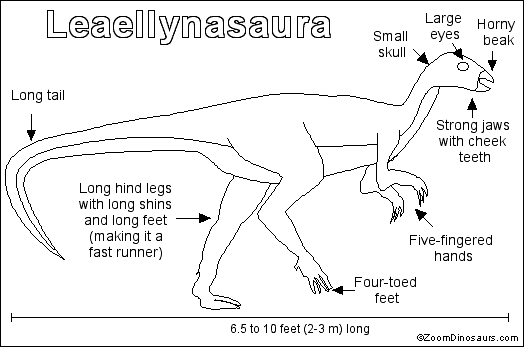
Leaellynasaura (pronounced lee-EL-in-a-SAWR-a) was a fast-running, plant-eating dinosaur that lived in Australia during the middle Cretaceous Period, roughly 115-110 million years ago. Australia was within the Antarctic Circle during the Cretaceous period, and it had a very long, dark winter. Leaellynasaura had large eyes that would have helped it find food during the long, dark polar winters.

Diet: Leaellynasaura was an herbivore (it ate only plants); it had a tough beak and many self-sharpening cheek teeth. It may have eaten cycads, ferns, and conifers.

Anatomy: Leaellynasaura was a small hypsilophodontid, a bipedal plant-eater 6.5 to 10 feet (2-3 m) long. Leaellynasaura had a relatively large brain, a cheek pouch, strong jaws, and good eyesight. Leaellynasaura was a hypsilophodont (dinosaurs with high-ridged teeth) but differed from other hypsilophodontids in its upper hind leg bone structure (at its base it gets wider from back to front).

Name: Leaellynasaura was named in 1989 after Leaellyn, the daughter of Thomas A. Rich and Patricia Vickers, the namers of the dinosaur; saura is the feminine form of lizard in Greek.


Enchanted Learning Search

First search engine with spelling correction and pictures!
Search EnchantedLearning.com for all the words:
Enter one or more words, or a short phrase.
You can use an asterisk * as a wild-card.


Zoobooks magazine for kids!
Advertisement.


Advertisement.


Copyright ©2000-2008 EnchantedLearning.com ------ How to cite a web page