
|
| Table of Contents | Enchanted Learning All About Astronomy |
Site Index |
| Our Solar System | Stars | Glossary | Printables, Worksheets, and Activities | ||||||
| The Sun | The Planets | The Moon | Asteroids | Kuiper Belt | Comets | Meteors | Astronomers | ||
 |
 |
||||||
| A | B | C | D | E | F | G | H | I | J | K | L | M | N | O | P | Q | R | S | T | U | V | W | X | Y | Z |
JANSKY The jansky (abbreviated Jy) is a unit of radio flux density (the rate of flow of radio waves); 1 Jy = 10-26 watts/m2/Hz. A typical radio source has a spectral flux density of roughly 1 Jy. The jansky was named to honor Karl Gothe Jansky who developed radio astronomy in 1932. |
JANSKY, KARL Karl Gothe Jansky (1905-1949) was an American radio engineer who pioneered and developed radio astronomy. In 1932, he detected the first radio waves from a cosmic source - in the central region of the Milky Way Galaxy. Jansky's work was continued by Grote Reber. |
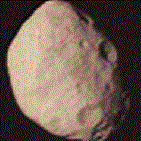 JANUS Janus is one of the smaller of the 18 moons of Saturn. This heavily-cratered moon orbits at a mean distance of about 94,000 miles (151,472 km) and revolves around Saturn in about 18 hours. Janus has a diameter of about 185 miles. Janus shares an orbit with Epimetheus (they are only separated by about 50 kilometers (31 miles)). Once every four years they approach each other, exchange some momentum and switch orbits. This icy moon was discovered by the French astronomer Audouin Dollfus in 1966. |
 JEMISON, MAE C. Mae C. Jemison (October 17, 1956 - ) was the first African-American woman in space. Dr. Jemison is a medical doctor and a surgeon, with engineering experience. She was accepted into NASA's astronaut program in 1987. She flew on the space shuttle Endeavor (STS-47, Spacelab-J) as the Mission Specialist; the mission lifted off on September 12, 1992 and landed on September 20, 1992. Dr. Jemison founded the International Science Camp in Chicago in 1994, a program designed to interest children in science and space. |
JETS Jets are blasts of particles that are emitted by an active galactic nucleus or a pulsar. Jets only occur in pairs, going in opposite directions. |
JET STREAM The jet stream is a high-speed wind that is usually found at high altitudes, between 25,000 and 45,000 feet (just below the tropopause). It is called the jet stream because the first people who encountered the jet stream were pilots who described it as though the wind was being propelled from a jet engine. |
JEWEL BOX The Jewel Box - NGC 4755 (also known as Kappa Crucis) is an open cluster of about 100 stars in the Southern Cross (a constellation in the Southern Hemisphere). Located near Beta Crucis, it was discovered by Abbe Lacaille when he was in South Africa from 1751 to 1752. This very young cluster is estimated to be under 10 million years old and is about 7500 light-years away from us. |
JODRELL BANK Jodrell Bank in northeastern Cheshire, England, is the location of a radio astronomy observatory, Nuffield Radio Astronomy Laboratories. The radio telescope's size is 250 ft (76 m). |
JOVIAN Jovian means of or relating to the planet Jupiter. |
JOULE A joule is the amount of work done by a force of one newton acting through one meter. |
JPL JPL stands for Jet Propulsion labratory. JPL is managed for NASA by the California Institute of Technology. JPL develops robotic devices for exploring the Solar System. JPL's main site is in the San Gabriel Mountains near Pasadena, California. |
JUNO Juno is a large asteroid, and one of the four brightest asteroids. It is about 240 km in diameter and its mass is roughly 2.0 x 10¹⁹ kg. It is about 2.7 AU from the Sun and takes 4.36 years to orbit the Sun once (its year). Juno was discovered by K. Harding in 1804; it was the third asteroid discovered. |
 JUPITER Jupiter is the largest planet in our solar system and the fifth planet from the sun. This gas giant has a thick atmosphere, 17 moons, and a dark, barely-visible ring. Its most prominent features are bands across its latitudes and a great red spot (which is a storm). |
Jy Jy stands for "jansky (named to honor Karl Gothe Jansky who developed radio astronomy in 1932)". The jansky (abbreviated Jy) is a unit of radio flux density (the rate of flow of radio waves); 1 Jy = 10-26 watts/m2/Hz. A typical radio source has a spectral flux density of roughly 1 Jy. |
|
|
||||||
| A | B | C | D | E | F | G | H | I | J | K | L | M | N | O | P | Q | R | S | T | U | V | W | X | Y | Z |
Enchanted Learning®
Over 35,000 Web Pages
Sample Pages for Prospective Subscribers, or click below
|
Overview of Site What's New Enchanted Learning Home Monthly Activity Calendar Books to Print Site Index K-3 Crafts K-3 Themes Little Explorers Picture dictionary PreK/K Activities Rebus Rhymes Stories Writing Cloze Activities Essay Topics Newspaper Writing Activities Parts of Speech Fiction The Test of Time
|
Biology Animal Printouts Biology Label Printouts Biomes Birds Butterflies Dinosaurs Food Chain Human Anatomy Mammals Plants Rainforests Sharks Whales Physical Sciences: K-12 Astronomy The Earth Geology Hurricanes Landforms Oceans Tsunami Volcano |
Languages Dutch French German Italian Japanese (Romaji) Portuguese Spanish Swedish Geography/History Explorers Flags Geography Inventors US History Other Topics Art and Artists Calendars College Finder Crafts Graphic Organizers Label Me! Printouts Math Music Word Wheels |
Click to read our Privacy Policy
| Search the Enchanted Learning website for: |