
| Join Enchanted Learning Site subscriptions last 12 months. Click here for more information on site membership. As low as $20.00/year (directly by Credit Card) |
||||
| Site members have access to the entire website with print-friendly pages and no ads. | ||||
| More Cloze Activities | Cloze Activity Fill in the blanks below. |
Answers |
| asteroid gaseous Mercury rock Sun |
ecliptic moons planets Jupiter Mars |
Earth center inner Solar System Pluto |
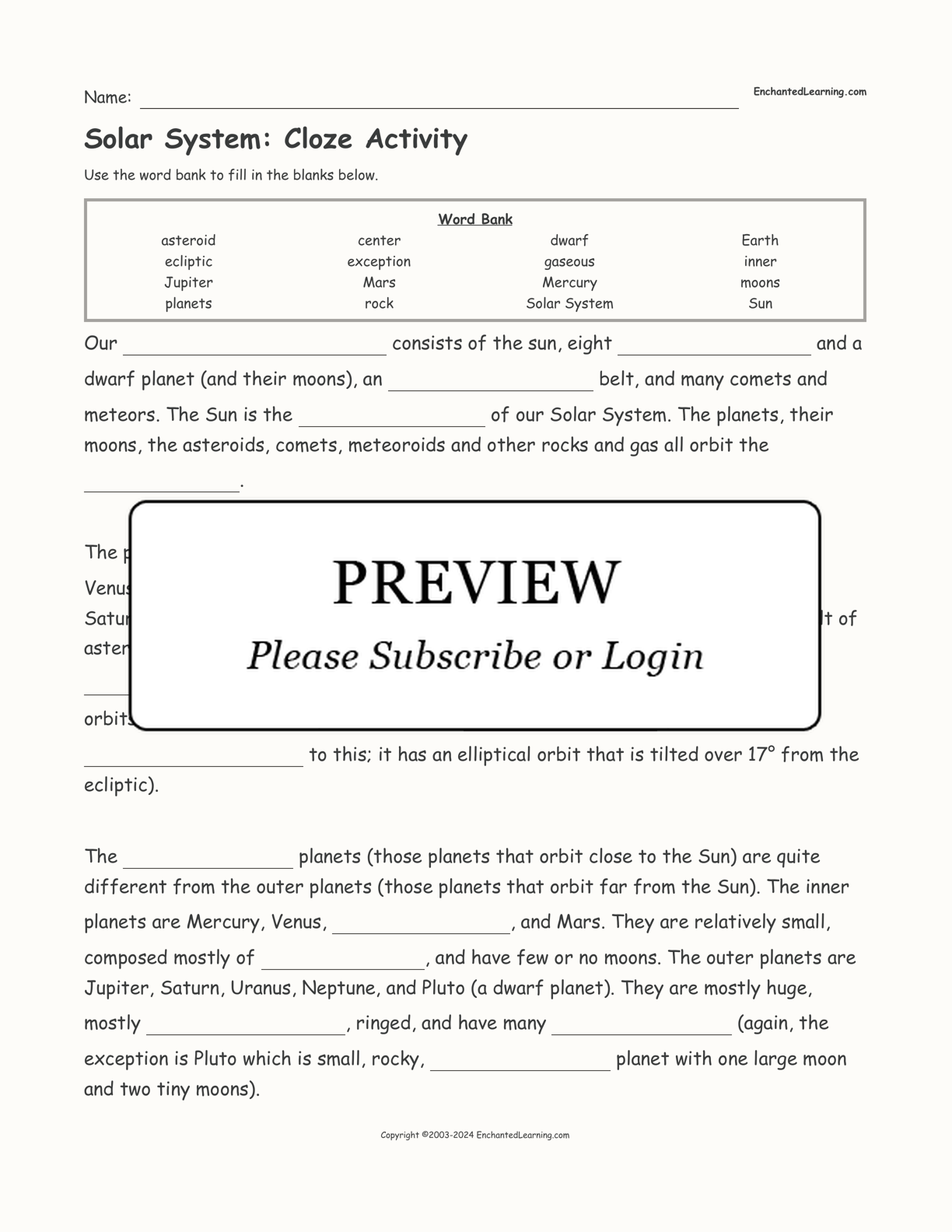
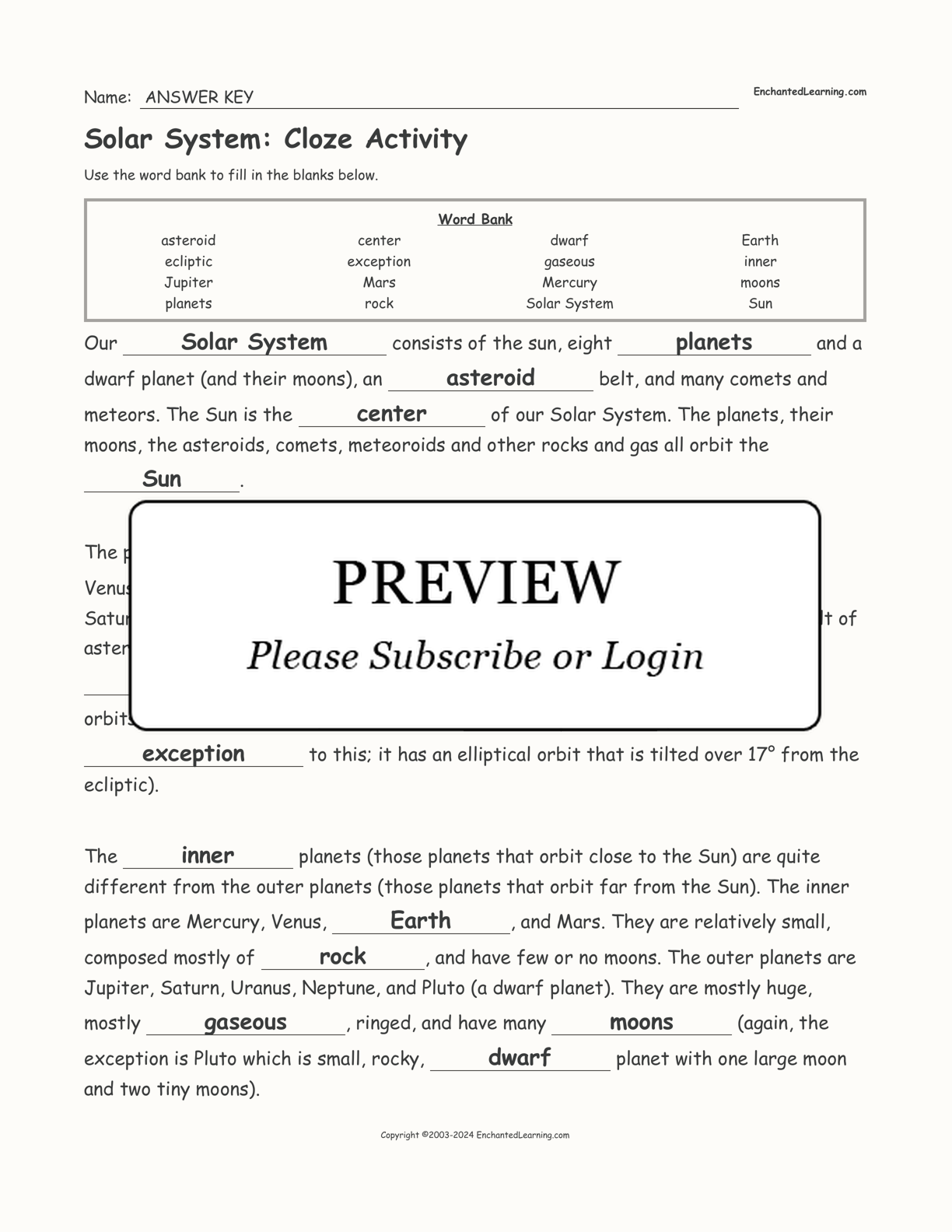
The planets that orbit the sun are (in order from the Sun): ____________________________, Venus, Earth, Mars, ____________________________ (the biggest planet in our Solar System), Saturn (with large, orbiting rings), Uranus, Neptune, and Pluto (a dwarf planet). A belt of asteroids (many minor planets made of rock and metal) orbits between ____________________________ and Jupiter. These objects all orbit the Sun in roughly circular orbits that lie in the same plane, called the ____________________________ (____________________________ is an exception to this; it has an elliptical orbit that is tilted over 17° from the ecliptic).
The ____________________________ planets (those planets that orbit close to the Sun) are quite different from the outer planets (those planets that orbit far from the Sun). The inner planets are Mercury, Venus, ____________________________, and Mars. They are relatively small, composed mostly of ____________________________, and have few or no moons. The outer planets are Jupiter, Saturn, Uranus, Neptune, and Pluto (a dwarf planet). They are mostly huge, mostly ____________________________, ringed, and have many ____________________________ (again, the exception is Pluto which is small, rocky, dwarf planet with one large moon and two tiny moons).
| Search the Enchanted Learning website for: |